
CMS will proceed evaluating OCSP and rising certificate administration applied sciences for optimizing key lifecycle security. Cryptographic key management governs the complete lifecycle of encryption keys — technology, distribution, storage, use, rotation, backup, and destruction — as a result of encrypted information is just as protected as its keys. For uneven encryption, which entails a pair of keys (a public key for encryption and a private key for decryption), CMS organizations will need to manually rotate keys. This is because the new public key have to be distributed to users before the new key pair can be utilized. Encryption key administration has the power to protect sensitive information whereas stopping unauthorized entry. Safe key management practices are essential, and thankfully, many wonderful choices promise to boost overall safety and compliance.

This makes such encryption key management options certainly one of your company’s most valuable property, and they should be handled as such. The value of any key’s equivalent to the value of all the data and/or property it’s used to guard. Additionally generally known as public-key cryptography, uneven encryption is a relatively newer encryption method that uses mathematically linked private and non-private key pairs to encrypt and decrypt knowledge between trusted events.
- This will facilitate the correct use and upkeep of cryptographic systems.
- If a key just isn’t available when required, or worse nonetheless misplaced as a result of some fault, accident or disaster with no backup out there, then the information it is defending can also be inaccessible / misplaced.
- After completion, you receive a certificate for one Continuing Educational Credit Score.
- In Accordance to the CMS ARS, CMS information methods must evaluate and replace their threat assessments no less than each three years, or sooner if there’s a serious change within the system.
Plan Your Structure
Not Like symmetric encryption’s single key mannequin, uneven encryption makes use of paired keys (public and personal keys) for extra robust security. Due To This Fact, messages encrypted using https://belairanimalpark.com/computer-technology-assistance-corps-ctac.html a public key can only be decrypted utilizing a private key. Messages encrypted using a personal key may be decrypted using a public key.
The power of the key ought to be applicable for the value of the info it’s protecting and the period of time for which it must be protected. The key ought to be long enough for its supposed function and generated utilizing a high-quality (ideally certified) random number generator (RNG), ideally accumulating entropy from an appropriate hardware noise source. Separate key lifecycle orchestration, hardware protection, cryptographic operations, workload authorization, and software knowledge coverage. Data that has been encrypted with lost cryptographic keys will never be recovered.
Key Rotation
The CMS Chief Info Officer (CIO), the CMS Chief Info Security Officer (CISO), and the CMS Senior Official for Privacy (SOP) collectively develop and preserve the CMS IS2P2. The CIO delegates authority and accountability to particular organizations and officials inside CMS to develop and administer outlined aspects of the CMS Info Security and Privacy Program as acceptable. Full lifecycleGeneration strength, rotation intervals, escrow or restoration choices, versioning for re-encryption, and verified destruction. Keys mustn’t ever exist in plaintext outside a secure boundary. A key in a config file, environment variable, supply code, or email is a compromised key.
An RKN could embrace the revocation cause and an indication of when the revocation was requested. The inclusion of the revocation purpose could be helpful in risk choices regarding the knowledge that was received or stored using those keys. Key administration refers to the secure dealing with of cryptographic keys within a cryptosystem. Managing keys contains producing, distributing, exchanging, storing, using and replacing keys as needed at the person level after which deletion or destruction when they are not needed.
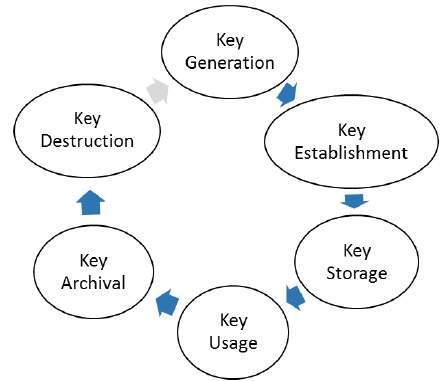
Key storage determines how and the place personal keys are positioned. This performs a elementary role in elevating private key safety. When utilizing SSL/TLS certificates, public keys are printed throughout the certificates itself, while personal keys may be stored in an encrypted format on onerous drives or USB tokens. Sturdy passwords and entry management might help to safeguard these private keys. Additionally, encryption and correct key management assist organizations meet crucial information safety regulations corresponding to GDPR, HIPAA, and PCI DSS, guaranteeing compliance while safeguarding delicate information.
Key Distribution

Where the worth of the information calls for it, keys should be encrypted every time saved and solely be made available in unencrypted form within a safe, tamper-protected setting and even (in extreme cases) saved offline. Pomerium accepts documented certificate, signing, shared-secret, and service-account configuration. Operators own era, custody, access, distribution, stock, rotation, revocation, restoration, and destruction. Pomerium can’t invalidate an exterior key or discover copies outside its configured deployment. CSA’s Cloud Key Administration Foundations course is predicated on our cloud key administration analysis initiatives and associated artifacts.
How Will You Provide A Clear Path To Complete Knowledge Security?
Cryptographic key administration is where encryption succeeds or fails. Here’s the method to handle keys throughout cloud, on-premises, and hybrid environments — with practical patterns for technology, storage, rotation, and destruction. After keys are generated, they can be securely shared between multiple events, allowing authorized individuals to send or receive encrypted information. This process could also be known as a key distribution or key change.
As digital gatekeepers, these keys keep information totally protected by controlling who can entry it. Rotation does not repair unknown copies, derived keys, cached sessions, backups, or a compromised issuer. A non-exportable key can still be abused by way of an authorized cryptographic API. Destroying one storage copy does not show that reminiscence, replicas, logs, and snapshots are clear. A cryptographic algorithm is a computational procedure or formula used to encrypt and decrypt data to make sure safety and privateness.